Concrete sidewalks and walkways in Cookeville and the Upper Cumberland
A walkway carries every guest, delivery and grocery trip from the drive to your door. We pour it wide enough to walk comfortably, pitch it so it sheds water instead of icing, and set it on a base that keeps it from heaving in winter.
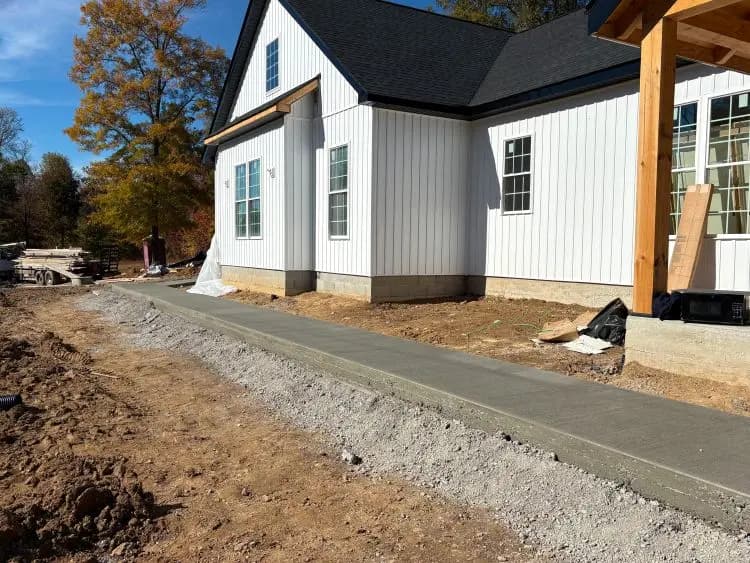
How much does a concrete sidewalk cost in Cookeville?
A walk is priced by its length and width, the finish, and how the route handles slope, steps and drainage. Walks are often added to a driveway or patio pour, which makes them easier to fit in. Joe measures the route on a free site walk and puts the firm price in writing.
What a sidewalk job involves
Joe walks the route with you, from where the path leaves the driveway or street to where it meets the porch or steps. He looks at the grade along the way, where a landing or a step will be needed, and how the walk should tie into an existing apron, stoop or patio. The width, route and finish go into the written estimate.
The crew excavates the path, places and compacts stone, and sets forms that hold the line and the curve you agreed on. Concrete is poured, screeded to the forms, edged and finished. Control joints are tooled or cut at regular intervals so the walk cracks at a joint rather than across the surface, and the crew backfills the edges before leaving.
Long runs, steps and walks that wrap the house take more forming than a straight front walk, and the crew will hold off on a day when the forecast would ruin the finish. Joe gives you the schedule with the written estimate.
Walk and path choices
Broom finish
The standard for a walkway. The light texture keeps footing sure in rain and frost, and it is simple to shovel and sweep.
Exposed aggregate
Stone showing through the surface for a garden path look that hides mud and leaf stains. It pairs well with the same finish on a patio or drive.
Stamped or bordered
A pattern or a contrasting band along the edges to match a stamped patio or a brick front. Colored and stamped walks cost more than plain broom and earn it where the walk is the focal point of the front yard.
Steps, landings and aprons
Poured steps where the grade changes, a landing at the door, or an apron where the walk meets the drive or the street. All of it is formed and poured as part of the same job.
How Morgan's pours a walkway
Sidewalks are finished by hand, and the hands belong to our own W2 crew. No day labor and no subcontracted crew works on your property. The supervisor standing over the pour is the English-speaking person who measured the walk and wrote the estimate.
Licensed and insured We dig and base the path ourselves, and we compact the stone under it, because a walk that settles at the joints is the one that turns into a trip hazard.
Josh runs the crew and checks the fall on every section, so water runs off the walk and away from the house. When the pour is done we are still here, and the office returns every call and request.
What affects the price
- Length and width of the walk, which set the square footage.
- Steps and landings, which take more forming and finishing than a flat run.
- Curves and tight turns compared with a straight run.
- Tearing out an old walk or pavers before the new one goes in.
- How much grade work the route needs to get a consistent fall.
- The finish, with stamped and exposed aggregate priced above broom.
Joe goes over each of these on the site walk and puts the firm number in writing.
Questions homeowners ask
How wide should a front walkway be?
A front walk that lets two people pass comfortably is generally wider than a side or utility path. Joe will suggest a width on the site walk based on how the walk is used and how it lines up with the door and steps, and you decide.
How thick is a residential sidewalk?
Walks that carry only foot traffic are commonly poured at four inches over compacted stone. Where a walk crosses a driveway or an apron takes vehicle weight, that section is poured thicker and reinforced like the drive.
Will my new sidewalk match the old concrete next to it?
New concrete is darker than concrete that has weathered for years, and it lightens over time. We can match the finish and the joint spacing so the walk looks like it belongs, and Joe will tell you honestly which parts will blend and which will show for a while.
Can you replace just a few broken sections?
Yes. We saw-cut at the nearest joint, remove the damaged panels, rebuild the base and pour new sections to the same thickness and line. If most of the walk is failing, replacing the whole run usually makes more sense, and Joe will say which he recommends.
How soon can we walk on it?
The wait before you walk on it is set by the mix and the weather that week. The crew tells you the date for your walk before they leave.
Do you pour the apron where the walk meets the street?
Yes. Aprons and street connections are part of the job. If the city requires a right-of-way permit, Joe goes over it with you before the work is scheduled.
Related answers
What to expect on pour day
The sequence on pour day: crew arrival, forms and base check, the truck, the pour, finishing, joints, cleanup, and what you need to do beforehand.
How long before you can drive on new concrete?
Walk on new concrete after about a day, park a car after about a week, and expect full strength near 28 days. Weather changes every one of those numbers.
Concrete driveway maintenance and sealing schedule
Keep a concrete driveway looking new: clean it each season, seal it on a schedule, skip the salt, keep the joints filled and know when to call for a look.