Concrete patios in Cookeville and the Upper Cumberland
A patio is the slab you will sit on, grill on and look at from the kitchen window every day. We shape it to the way your family uses the yard, pitch it so water runs away from the house, and finish it to suit the home it sits behind.
How much does a concrete patio cost in Cookeville?
Patio pricing depends on the square footage, the finish you choose, steps or borders, and how much grading the yard needs. The fastest way to a real number is a site walk: Joe measures, talks through finishes that suit the house, and puts the firm price in writing at no cost.
What a patio job involves
The visit starts at the back door. Joe looks at where the door threshold sits, how the yard falls away from the foundation, and where downspouts and grade will push water once a slab is in place. He measures the footprint you have in mind, talks through where furniture, a grill or a fire feature will go, and writes the estimate from that conversation.
The crew strips sod and topsoil, brings in and compacts stone, and sets forms to the shape and fall Joe laid out. Reinforcement goes in, the pour is placed and screeded, and the finish is worked in as the surface sets up. Joints are cut in a layout that follows the shape of the patio so the lines look planned rather than random.
Forming, pouring and finishing are planned around the layout and the forecast. Curved edges, steps and an upper level add time, and so does rain, so Joe gives you the schedule with the written estimate.
Finish and layout choices
Broom finish
A fine broom texture is the most common patio surface. It gives bare feet and chair legs grip when the slab is wet, and it is the least expensive of the finishes we offer.
Exposed aggregate
The surface paste is washed off to reveal the stone in the mix. It hides dirt and leaf stains well and reads as a landscape material instead of plain gray concrete.
Stamped and colored
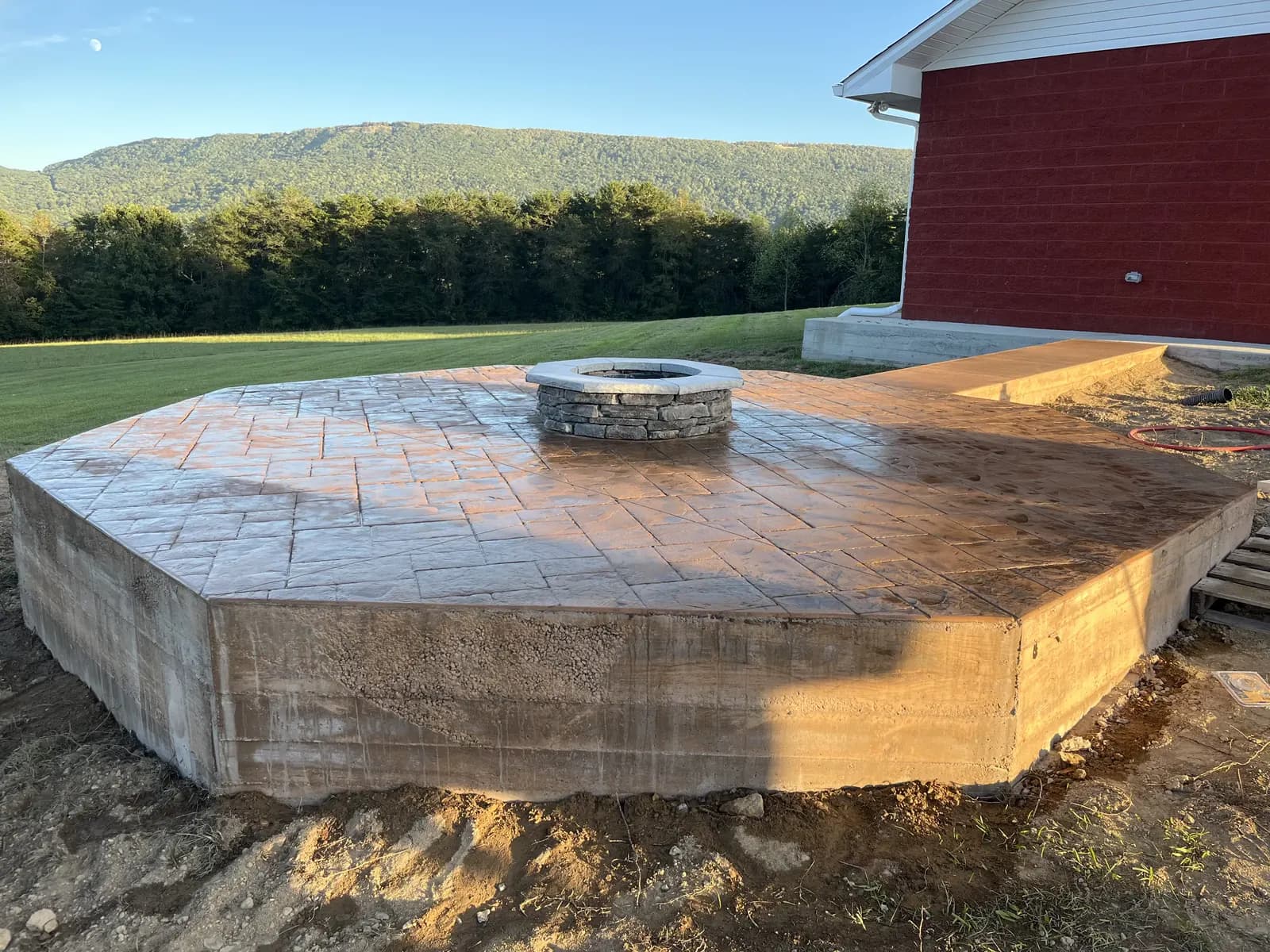
Pattern and color pressed and worked into the surface for a look closer to flagstone, slate or brick. See the stamped and decorative page for the patterns and colors we run.
Steps, landings and borders
A step down from the door, a landing at the grill, or a contrasting band around the edge. These are formed and poured as part of the same job so everything ties together.
How Morgan's builds a patio
The people forming and finishing your patio are Morgan's employees on our own W2 payroll. We do not send day labor or a subcontracted crew into your backyard, and the English-speaking supervisor on site is the same person who walked the yard and bid the job.
Licensed and insured We handle the grading and stone base ourselves before a form is set, so the slab is bearing on compacted ground and pitched to drain away from your foundation.
Josh runs the crew on pour day and stays with the slab through finishing and joint cutting. Once the patio is poured we are still the company you call, and the office returns every call and request.
What affects the price
- The size of the patio, which drives most of the estimate.
- The finish you choose, with stamped and exposed aggregate above broom.
- Steps, landings, curves and an upper level, which take more forming.
- How much dirt has to move to get the slab level and draining the right way.
- Removing an old patio, deck or paver surface before the new slab goes in.
- How close the concrete truck can get to the backyard, and whether the crew has to wheel material through a gate.
Joe goes over each of these on the site walk and puts the firm number in writing.
Questions homeowners ask
How thick is a concrete patio?
Patios that carry furniture and foot traffic are typically poured at four inches over a compacted stone base, with reinforcement in the slab. If a hot tub or a heavy outdoor kitchen is going on the patio, Joe designs that area thicker and notes it in the estimate.
Will the patio drain away from my house?
Yes. The slab is pitched a small amount away from the foundation so rain and snowmelt run off into the yard. Joe checks the existing grade and the door threshold on the site walk to make sure that fall is possible without a step or a trip edge at the door.
How long until we can use the patio?
Light foot traffic comes first, and furniture, a grill and heavier use wait longer. Cool or wet weather slows curing, so the crew gives you the dates for your slab before they leave.
Can you add a patio to an existing porch or slab?
Yes. We form the new section to meet the old one and place an expansion joint between them so the two slabs can move independently. An exact color match to older concrete is not possible, since concrete lightens as it ages, and Joe will say so up front.
Do you seal patios?
Sealing is optional on broom-finish patios and recommended on stamped and colored work to protect the color. It is a line item on the estimate so you can decide, and Joe goes over the sealer and the resealing schedule for your finish at the site walk.
Do you pour patios in the cold months?
We pour whenever the forecast gives us the temperatures concrete needs, and we schedule around it the rest of the time. The crew confirms your pour date once the forecast is clear.
Related answers
Stamped concrete vs pavers for a Tennessee patio
A fair look at stamped concrete and pavers for a Middle Tennessee patio: look, cost drivers, maintenance, freeze and thaw, weeds, settling and repairs.
Best time of year to pour concrete in Middle Tennessee
Spring and fall give Middle Tennessee the mild temperatures concrete likes. Summer and winter pours work with precautions. Book spring during winter.
What to expect on pour day
The sequence on pour day: crew arrival, forms and base check, the truck, the pour, finishing, joints, cleanup, and what you need to do beforehand.